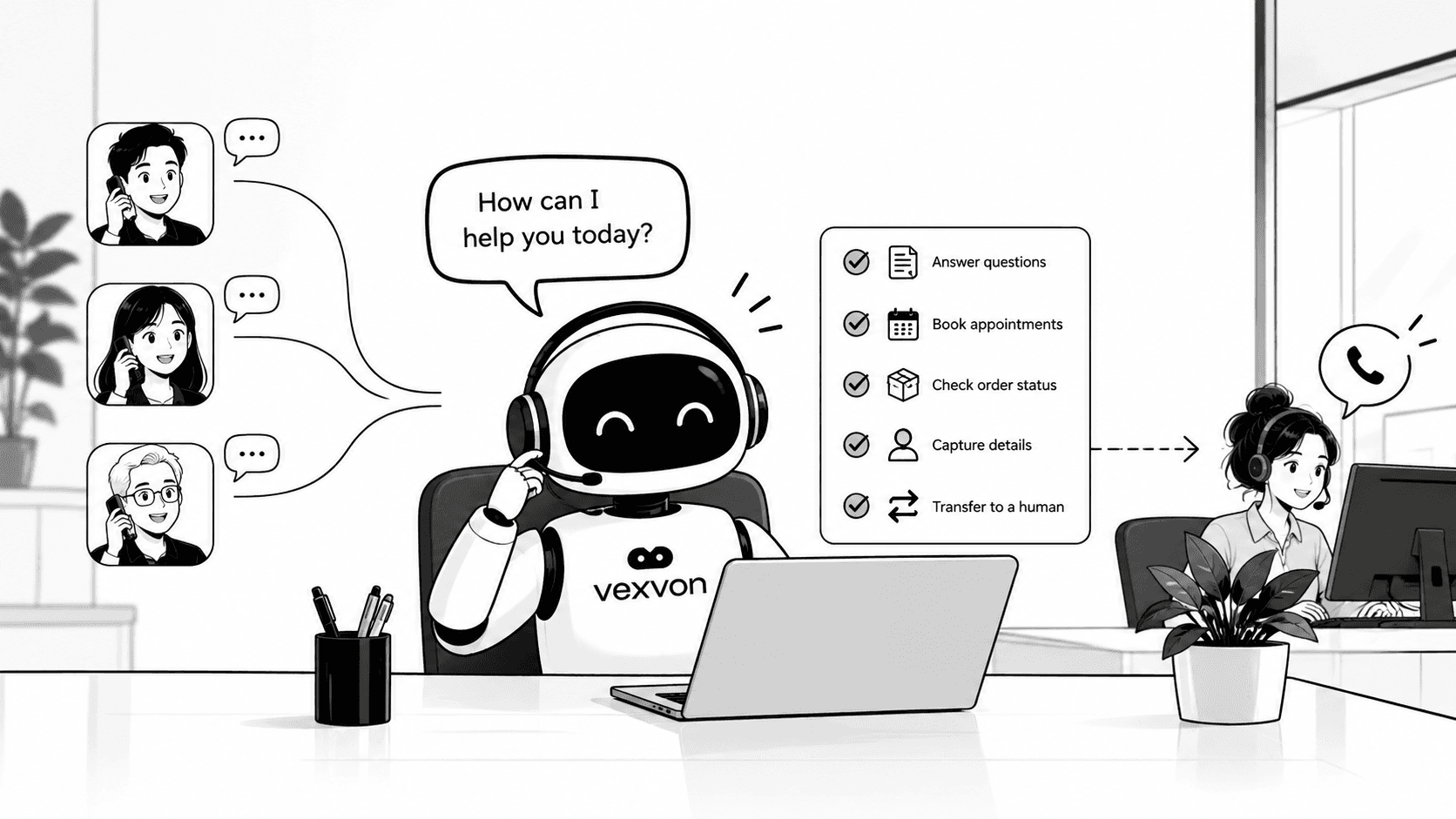
What Is an AI Call Center and How Does It Work?
An AI call center is a phone line answered by a voice AI agent instead of a queue. It picks up immediately, holds a real conversation about the things your customers routinely ask, writes down what was said and what it means, and transfers the call to a person when it should. It runs on the phone system you already have, so your customers keep dialling the same number. This guide covers how a call actually runs, what the agent needs underneath it to answer correctly, which calls should never be automated, and the questions worth asking a vendor before anything reaches a real caller.
What an AI call center actually is
An AI call center is a phone line where the first voice a caller hears belongs to software that can hold a conversation. The agent answers, understands the question, replies from your own material, collects the details you need, and either resolves the call or transfers it to a person. Nothing about the customer's side changes: the same number, the same phone, no app to install.
The phrase is used loosely, so it is worth separating from three neighbouring things. A contact-centre platform is the software your human agents work in — queues, wallboards, quality scoring. An IVR is a menu. An answering service is a person or a machine that takes a message. An AI call center is the only one of the four in which a machine holds the conversation itself and produces structured output from it.
- IVRA fixed menu with keypad routing. It cannot answer a question that was not anticipated, and every extra option makes the tree worse.
- Voicemail or answering serviceTakes a message. The customer's problem is unresolved when they hang up, and someone still has to call back.
- Contact-centre platformRuns the human operation: routing, queueing, recording, reporting. The talking is done by staff.
- AI call centerAnswers, converses, extracts structured detail, and escalates by rule. It sits on top of the line rather than replacing your telephony.
Where inbound calls are actually lost
Missed calls are not distributed evenly. They cluster in three situations, and in all three the caller does the same thing — dials a competitor.
- Outside working hours. The day ends and the calls do not. An evening or weekend call rarely comes back the next morning, because by then the customer has solved the problem elsewhere.
- When the line is busy. Three people call at once and two hear an engaged tone. How many of them try again is not measured anywhere, because there is nothing left to measure.
- On the fifteenth identical question. Opening hours, address, price, whether something is in stock. These consume the same agent minutes as the calls that genuinely need a person.
The third is the most expensive and the least visible. It does not show up as a missed call; it shows up as your best agent being unavailable for the call that mattered. For a small team, where one missed call can be a lost week, the picture is set out in AI call center for small businesses.
How a call runs, from ring to record
A well-built AI call runs through the same stages every time. Understanding them is what lets you judge where a particular vendor is weak.
- The call is routedBefore the agent is involved, a rule set decides whether this call should reach it at all — based on the number dialled, the hour, the day, or the caller's number.
- The agent answers and identifies the needNo hold music, no menu. The caller says what they want in their own words.
- The question is answered from your materialThis is the part that determines whether the system is useful or dangerous. The agent should be answering from your catalogue, prices, policies and documents — not from a general model's guess about your business.
- Live data is fetched if the answer needs itOrder status, stock, an available appointment slot. A static knowledge base cannot answer 'is it in stock right now'; a tool call to your own system can.
- Details are captured as they are saidName, number, service, date — whatever the scenario defines. Captured during the conversation, not reconstructed afterwards.
- The call ends, or a person takes itResolution, booking, or transfer with context. The three legitimate endings.
- The record is writtenTranscript, recording, one-sentence summary, extracted fields and outcome, filed against the customer rather than against the campaign.
The phone-system question, and who ever reaches the AI
This is the objection that kills most deals, and it deserves a direct answer: you should not have to change your number, your carrier or your PBX to put an AI agent on the line. A serious product connects over a SIP trunk, an IP PBX or a carrier line and sits in front of what you already run.
- SIP trunk or an existing IP PBX connection, with several DID numbers if you use them.
- Live registration status visible to you — so that when a connection drops, you hear it from your panel and not from a customer.
- A ceiling on concurrent calls, which is what determines whether five simultaneous callers all get answered.
- Your existing number, unchanged. Number portability problems are the most common reason a promising pilot never launches.
Routing is the second half of the same question, and it is where you keep control. Rules are read in priority order: the first one that matches wins and the rest are never evaluated. A practical rule set separates working hours from out-of-hours, sends known VIP numbers straight to a person, and gives everything else to the agent with a handover path behind it.
Which inbound calls to automate first
Not every call type is equally suited to a voice agent, and the order you automate them in decides whether the project builds trust or spends it. The rule of thumb: start where the question is repetitive, the answer is written down somewhere, and the cost of a delayed reply is high.
- Opening hours, address, availabilityThe highest-volume, lowest-risk category. The answer already exists on your website, it does not change during a conversation, and getting it wrong is easily corrected. Automate this first; it also gives you a month of recordings to review cheaply.
- Price and stock enquiriesValuable, but only if the agent can reach live data. A price read from a stale list is worse than no answer. Automate this once the catalogue is connected, not before.
- Appointment and booking enquiriesA strong fit, because the conversation has a clear shape: offer the free slots, take the choice, capture a name and a number. It also produces the cleanest structured output of any call type.
- Out-of-hours and overflowNot a topic but a time window, and usually the fastest measurable win — these calls are currently going nowhere, so anything the agent captures is net new.
- Complaints, negotiations and regulated adviceDo not automate. Route these to a person by rule, and make the rule explicit rather than hoping the agent recognises them mid-call.
A useful sequencing test before you add a new call type: can you write the correct answer down in a paragraph, and would every person in your company write the same paragraph? If yes, the agent can handle it. If no, the problem is not the AI.
What every call should leave behind
A voice agent that answers well but records nothing has automated the conversation and lost the data. What the call leaves behind is what your CRM, your reporting and your next conversation with that customer are built on.
- The full transcript of the call.
- The audio recording, on the same customer record.
- A one-sentence summary — who called and what they wanted.
- The fields defined in the scenario: service, date, product, city, amount, whatever your process needs.
- The outcome, and where relevant a booking or a follow-up task.
One rule tells you whether the extraction layer can be trusted: a field the agent did not hear must stay empty. A system that fills a slot because the schema has one will fill your CRM with confident nonsense, and you will not find out until someone acts on it.
What an AI call center is good at — and what it is not
The honest version of the benefit is narrower and more useful than 'AI answers your calls'. It is this: the calls that are repetitive, predictable and out of hours stop competing with the calls that need a person.
- Coverage. Evenings, weekends and public holidays stop being a gap where enquiries disappear.
- Concurrency. Simultaneous callers are answered simultaneously; the engaged tone stops being a silent leak.
- Consistency. The same question gets the same answer at 9am and at 11pm, because both come from the same material.
- Structured data. Every call produces a record, which is the input your reporting has always been missing.
- Triage. Your agents spend their day on the calls where human judgement changes the outcome.
The limits are equally specific, and stating them is what makes the rest credible:
- It is only as accurate as the material behind it. An outdated price list produces a confident, wrong answer at scale.
- It should not negotiate, approve exceptions, or handle a complaint through to resolution.
- Regulated conversations — clinical advice, financial guidance, anything with a legal obligation attached — need a human and, usually, a compliance review before automation is discussed at all.
- Call recording carries notice and consent obligations that vary by country. Check them before the line is live, not after.
- It does not replace a call centre team. It changes which calls that team gets.
Measuring the benefit is where most deployments get vague. Call volume answered is not a result; it is activity. The figures worth holding a pilot to are the ones that were previously unmeasurable: how many calls arrived outside working hours and were answered, how many callers got a resolution without reaching a person, and how many bookings or leads came out of calls that would otherwise have gone to voicemail. Those are countable from the first week, and they are the numbers a finance director will accept.
How to evaluate AI call center software
Bring your own difficult call to the demo. These are the questions that separate products once the scripted demo is over. The full requirements list to take into procurement is in the AI call center software buyer's checklist. How to run those live test calls step by step is set out in a demo checklist for choosing an AI call center vendor.
- Where do the answers come from?Ask the vendor to show which piece of your material produced a given answer. If they cannot, you have no way to fix a wrong answer at its source.
- What happens when it does not know?The correct behaviour is to say so and hand over. Anything else is a liability that scales.
- How does the handover work?Mid-call transfer to a person, with the conversation so far visible to whoever picks up.
- What telephony does it support?SIP trunk, IP PBX, carrier line, multiple DIDs, and a visible registration status.
- How many calls at once?Concurrency is usually a commercial limit rather than a technical one. Find the number before you sign, not during your busiest week.
- What languages, and how are they chosen?Per number, per scenario, or detected from the caller — the answer determines whether a multilingual market is served properly or approximately.
- What comes out of each call?Transcript, recording, summary, extracted fields, outcome — automatically written to the customer record.
- Can you see what it cost?Per-call cost visibility is what turns 'the AI bill' from a surprise into a managed line item.
How Vexvon handles inbound calls
Vexvon's call agent runs on top of the line you already have: a SIP trunk, an IP PBX or a carrier connection, with AzInTelecom, Twilio and on-premise PBX connections supported. Several DID numbers can sit behind it, the registration status of the line is visible live in the panel, and the number your customers know does not change.
Which calls reach the agent is decided by routing rules that are read in priority order — working hours to the agent, out-of-hours to a different scenario, a VIP list straight through to the sales team. A rule set can be simulated before it goes live, so the panel answers the question of where a given call would land without anyone having to place it.
The agent answers from the same knowledge base as the Vexvon chatbot, with material targeted at the chatbot, the call agent, or both — so a price written once is the same in a WhatsApp message and on the phone. Mid-call it can transfer to an operator, end the call, or search the knowledge base, and your own API can be registered as an additional tool for live data. Scenarios set the language, the voice — eight are available — and the fields to extract.
What is left afterwards is a transcript, a recording, a one-sentence summary and the extracted fields on the customer's record. Because messaging channels and the phone line sit on the same account, a caller who first asked a price on Instagram appears as one customer history rather than two unrelated records. The people on the other end of a transferred call need practice too: here is an AI practice model for call center sales operators. If your phone team is outsourced, the governance model in outsourced call center and AI voice agent applies.
Frequently asked questions about AI call centers
- What is an AI call center?A phone line answered by a voice AI agent that holds the conversation, answers from your own material, captures the details you need and transfers to a person when it should.
- How is an AI call center different from an IVR?An IVR offers a fixed menu and routes on a keypress; it cannot answer an unanticipated question. An AI agent understands what was said in the caller's own words and answers it.
- Can an AI phone agent transfer a customer to a human?Yes, and it should — on request, on escalation rules, or when it has no grounded answer. The transfer should carry the conversation so far, so the person picking up does not start from nothing.
- Can AI call-center software connect to SIP or PBX systems?Yes. A serious product connects over a SIP trunk, an IP PBX or a carrier line and keeps your existing number. Vexvon supports AzInTelecom, Twilio and on-premise PBX connections.
- Can AI phone agents speak multiple languages?Yes. The language is set in the scenario, so one number can run in one language and another number in a different one.
- Can AI call-center conversations be transcribed and summarised?Yes. A full transcript, the audio recording, a one-sentence summary and the fields defined in the scenario should all be written to the customer record automatically as the call ends.
Start with the calls you are already losing
The easiest place to start is not your main line. It is the calls you already know you are missing: after six in the evening, at weekends, and when the line is engaged. Route only those to an agent for a month, listen to the recordings, and you will have your own answer rather than a vendor's.
The product side: Vexvon AI call center.